Arrival at Sobibor Station: Reconstructing the Deportation Process from Testimony and Evidence
Sobibor was established in the spring of 1942 in a remote, forested area near the railway line connecting Lublin and Wlodawa in occupied Poland. It was the second camp built as part of Operation Reinhard, the German plan to murder the Jews of the General Government, alongside Belzec and Treblinka. The camp was deliberately placed beside an existing railway spur and close to the small Sobibor station to allow transports to arrive directly at the camp boundary without passing through a major town. This isolation was intentional, designed to hide its purpose and to limit observation by the local population.
The Railway Connection and Why Location Mattered
The spur that served Sobibor branched off the main east-west line. German railway documents show that the camp had its own siding and ramp inside the outer fence, while the public Sobibor station building remained outside. Trains carrying deportees would first stop at the public station area for logistical checks, then be pushed forward onto the camp siding. Site research, including wartime aerial photographs and postwar mapping, confirms this two-stage movement. The forested surroundings and the single-track line meant that arrivals could be controlled and screened from outside view, a pattern also seen at the other Reinhard camps.
Deportations to Sobibor: What Transport Records Reveal
Transport records form the most precise source for understanding deportations to Sobibor. German railway timetables, correspondence between railway authorities and the security police, and surviving manifests document transports from ghettos and transit camps across occupied Poland, as well as from the Netherlands, Slovakia, France, and the occupied Soviet territories. Most transports took place between May 1942 and October 1943, with a peak in the spring and summer of 1943. The records show crowded freight cars, often carrying between 1,000 and 2,000 people per transport, with journeys lasting from several hours to several days under severe conditions without adequate water, food, or sanitation. Many deportees died during transit, and the documents also record requests for the return of empty cars, which helps historians confirm the scale and timing of arrivals even when other paperwork was destroyed.
What Happened to Deportees After They Arrived at Sobibor Railway Station?
What happened to deportees after they arrived at Sobibor railway station is central to understanding the camp’s function as an immediate killing center. The process was designed to move people from the train to the gas chambers as quickly as possible while preventing panic and resistance through deception. Testimony from the small number of survivors, from railway workers who observed the station area, and from postwar trials of camp personnel all describe a similar sequence, which is also supported by the physical layout uncovered by archaeologists.
The First Minutes on the Ramp
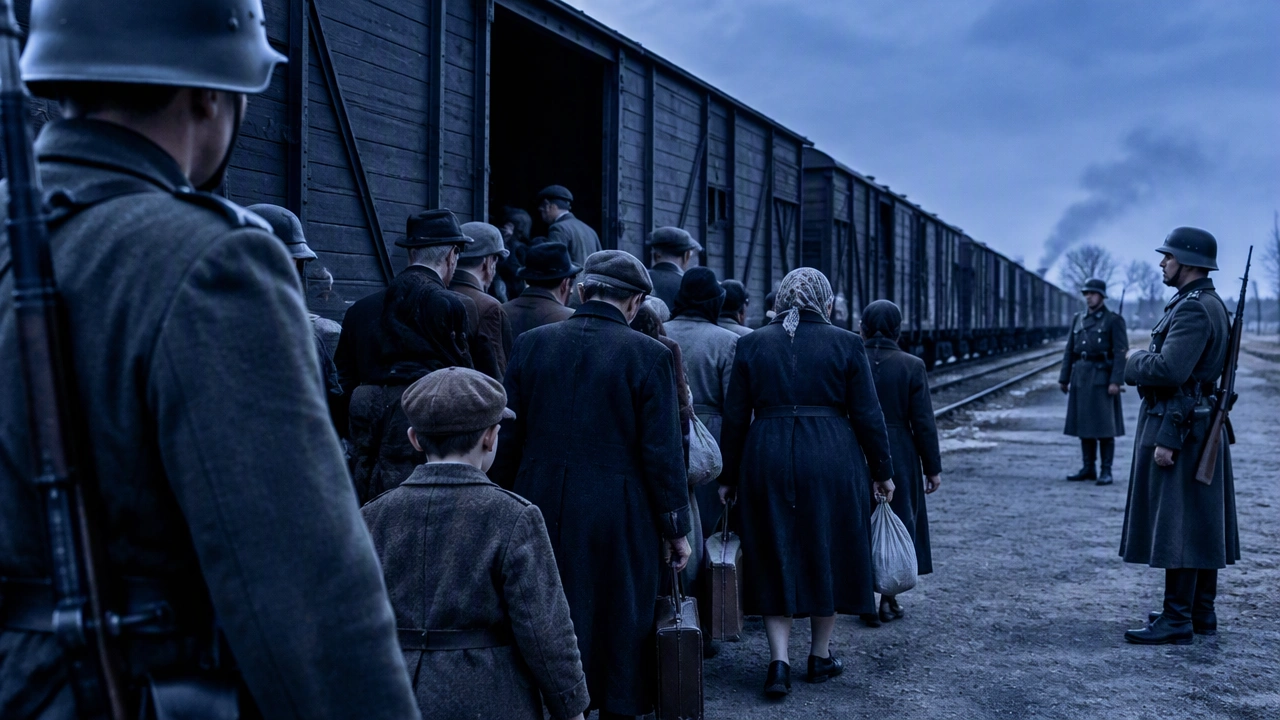
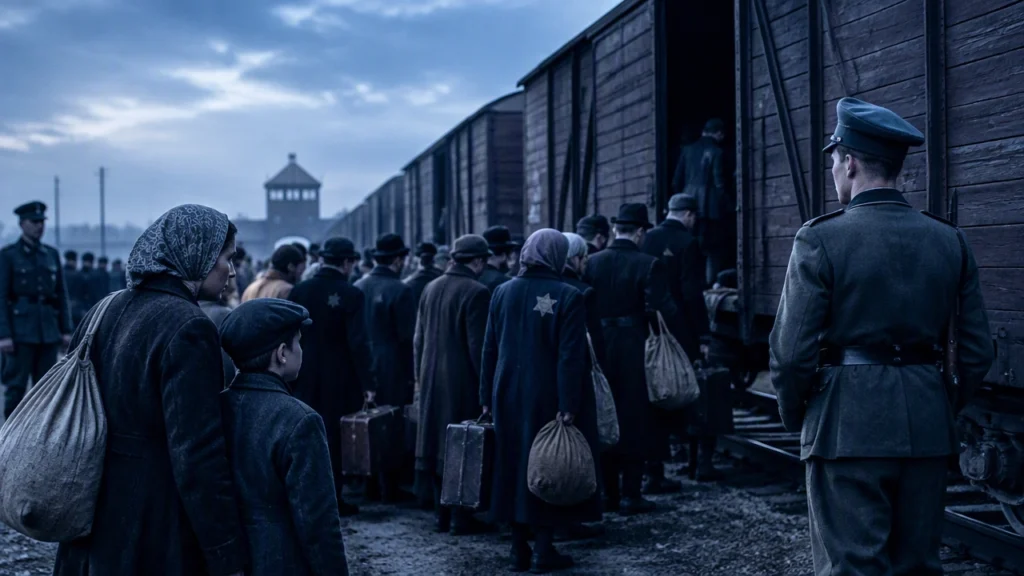
After the train was pushed onto the camp siding, the doors were opened by guards. Deportees, often exhausted and disoriented, were ordered onto a narrow platform or ramp. Guards and camp personnel, frequently with the help of trained dogs, shouted orders to move quickly and to leave baggage on the platform. An announcement was often made that the arrivals had reached a transit or labor camp and that they would be showered and disinfected before being sent onward. This false explanation was a consistent element in survivor accounts. Luggage was collected and taken to sorting barracks, creating the impression of an orderly registration process. Those who were too weak to leave the cars were removed separately.
Separation and the Route Through the Camp
On the ramp, a rapid selection took place. A very small number of people — often young men with perceived trade skills such as carpentry, metalwork, or tailoring — were sometimes pulled aside for forced labor inside the camp. This group was kept alive temporarily to maintain the camp’s operations, sort belongings, and handle bodies. The vast majority, including women, children, and elderly people, were directed along a fenced path. Survivors described this route as a barbed-wire-enclosed walkway that led from the ramp area into the reception area known as Camp II. There, they were told to undress, ostensibly for showering. Women and children were often separated from men at this stage. Personal documents, valuables, and clothing were surrendered and sorted. From Camp II, groups were led along a concealed, roofed or camouflaged corridor, often called the tube or road to heaven by perpetrators, which led directly to the gas chamber building in Camp III. The entire sequence from arrival to murder typically took only a few hours, and for most transports, no formal registration of names ever occurred inside the camp.
How Historians Reconstruct the Arrival: Testimony and Physical Evidence
No single source tells the full story of arrival at Sobibor. Because the Germans destroyed much of the camp before abandoning it after the prisoner revolt in October 1943, historians must combine several types of evidence and compare them carefully.
- Transport records establish when and from where trains departed and the approximate number of people on board.
- Testimony describes what deportees saw and heard on the ramp and in the reception area.
- Archaeology confirms the physical layout of the siding, ramp, and fenced corridors.
Voices of Survivors and Witnesses
Fewer than sixty people are known to have survived Sobibor, and their postwar testimonies are essential. Although each account reflects personal perspective and memory, common details about the ramp, the deception, the undressing area, and the fenced path appear repeatedly. Additional information comes from testimony of local railway workers who saw trains arrive at the station, and from statements made by camp guards and administrators during investigations and trials in the 1950s and 1960s. When these accounts are compared, historians can identify consistent patterns while remaining careful about individual variations and the limits of memory.
Archaeology and Site Research
Since the 2000s, archaeological excavations at Sobibor have provided physical confirmation of the structures described in testimony. Researchers have uncovered the foundations of the ramp and siding, the remains of the gas chamber building, and the post holes of the fences that formed the tube. The discovery of large numbers of personal objects, foundations of barracks, and the layout of Camp II and Camp III has allowed specialists to map the route deportees were forced to take with greater precision. Combined with wartime photographs, maps, and railway documents, this work helps verify the sequence of arrival without relying on any single source alone.
Reconstructing the arrival process at Sobibor is not an attempt to recount every individual experience, which is impossible given that most victims were murdered immediately and left no record. Instead, it is a careful effort to explain, with respect for the victims and accuracy about the evidence, how the camp operated as a place of mass murder. By bringing together transport records, testimony, and site research, historians can answer with clarity what the railway station represented: not a stop on a journey, but for the vast majority of deportees, the final point of arrival.