The Sobibor Uprising: A Minute-by-Minute Account of the 14 October 1943 Escape
The history of Sobibor requires precision. The camp was a Nazi German killing center in occupied Poland, part of Operation Reinhard, where most people deported there were murdered shortly after arrival. On 14 October 1943, prisoners organized a carefully prepared revolt. This account reconstructs What happened during the Sobibor uprising and escape on 14 October 1943? by following the sequence of events while distinguishing what is well supported from what remains disputed.
Background: the camp and the resistance
Sobibor operated from May 1942 until the uprising. By autumn 1943, the killing process had changed, and a smaller prisoner population was kept for labor, including dismantling and rebuilding parts of the camp. Among them were Soviet prisoners of war, many with military training, alongside Jewish prisoners from several countries.
Resistance had been considered before. An earlier escape attempt in June 1943 failed, and its suppression increased the danger for everyone. Even so, a planning group formed around Alexander Pechersky, a Soviet Jewish officer, and Leon Feldhendler, a Polish Jewish prisoner who understood the camp’s routines. Their plan was unusually ambitious: kill selected guards quietly, then break out in groups during the afternoon roll call.
Confirmed: the uprising began on 14 October 1943 and involved coordinated killings of guards followed by a mass escape. Disputed or imprecise: accounts differ over exact numbers of prisoners and guards, the timing of individual events, and who gave particular orders at each moment.
Before the alarm: preparation
During the morning, prisoners carried out normal work assignments to avoid arousing suspicion. Small groups were assigned to lure specific German or Ukrainian guards into isolated places, where attackers waited with axes and knives. Weapons were scarce; the conspirators depended on speed, surprise, and concealment.
The schedule was tight. Each killing had to occur before the next guard noticed a missing colleague. At the same time, prisoners not directly involved in the attacks had to remain calm and continue their routines. The plan also required a clear signal for the general breakout, because the camp’s watchtowers and fences made an uncoordinated rush likely to fail.
Confirmed: the conspirators used deception to separate guards and attack them one by one. Uncertain: the exact minute each victim was lured away, and the precise order in which certain guards were killed, vary in survivor testimony.
Midday: the killings begin
Shortly before midday, the first attacks started. Guards were invited to fitting rooms, workshops, or other secluded areas on the pretext of work or equipment checks. There, prisoners struck quickly and hid the bodies. The operation progressed through several locations, but the timing was never perfectly synchronized.
As the morning turned into afternoon, tension rose. Some guards became suspicious when colleagues did not return. The conspirators adapted, accelerating parts of the plan and postponing others. This is where memory becomes uneven: different witnesses emphasize different moments, and later reconstructions sometimes smooth over hesitation or delay.
Confirmed: multiple guards were killed before the alarm, and the attackers attempted to maintain secrecy as long as possible. Disputed: the total number of guards killed during the operation and the exact time the camp authorities realized that something was wrong.
Afternoon: alarm, breakout, and fire
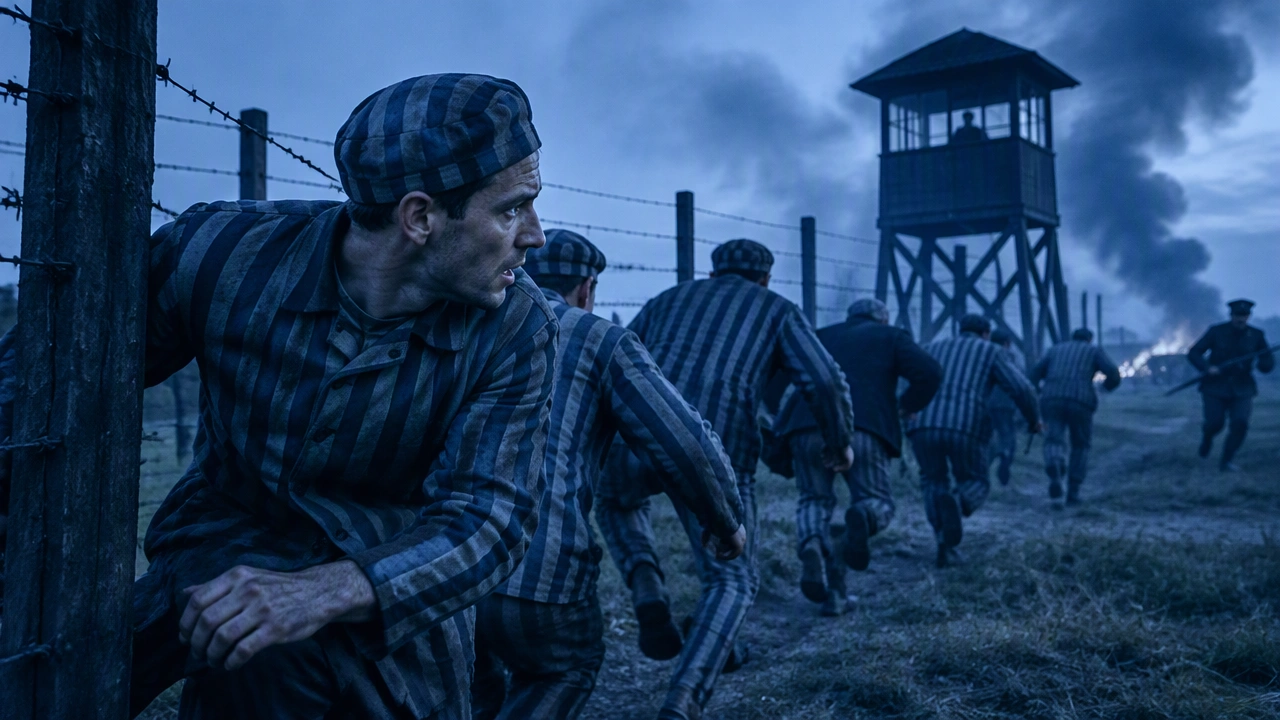
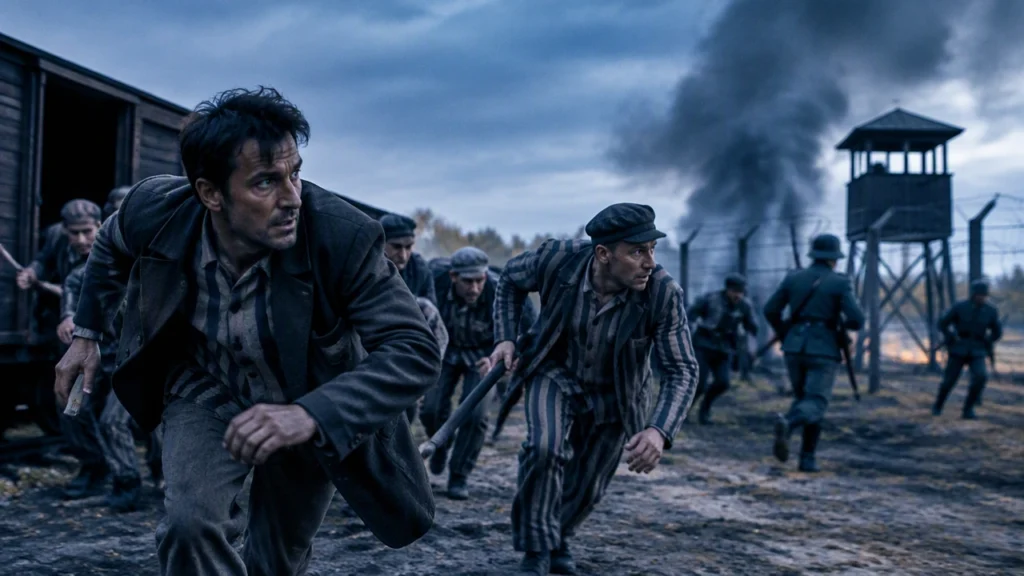
The secrecy could not last. When guards noticed missing staff or suspicious behavior, shooting began and the camp’s perimeter came under tighter watch. The planned roll call became the trigger for the main escape. Prisoners rushed toward the fences, cutting wire where possible and using gaps created during the attacks.
Some groups broke out together; others became separated in the confusion. Watchtowers fired on escapees, and search parties followed them into the surrounding forests and fields. Prisoners also set fire to camp buildings, including barracks and administrative structures. The fires destroyed records and complicated the pursuit, but they also created chaos that helped some groups disappear.
Confirmed: the escape involved a mass rush through the perimeter, gunfire from guards, and fires in the camp. Uncertain: the exact route taken by every group, the sequence in which specific fences were breached, and some casualty figures reported in early accounts.
Aftermath: survival, pursuit, and the end of Sobibor
Not everyone who left the camp survived. Some escapees were shot during the breakout or in the days that followed. Others were captured by German forces or local collaborators. A smaller number managed to hide, join partisan units, or reach safe shelter. The exact number of survivors has been estimated differently over time, and careful historians treat precise totals cautiously because records are incomplete and testimonies sometimes conflict.
The German authorities responded with searches and reprisals. The uprising helped prompt the decision to dismantle Sobibor. In the weeks that followed, the SS forced remaining prisoners to dismantle parts of the camp, then killed many of them and destroyed evidence. After the war, trials and investigations relied on survivor testimony, physical evidence, and German records, producing a detailed but not perfectly uniform picture.
What is established, and what remains uncertain
The broad sequence is clear. Prisoners organized a revolt, killed a number of guards during the morning and early afternoon, triggered a general escape, and set fires to hinder pursuit. The uprising occurred on 14 October 1943, and it was one of the few organized escapes from a Nazi killing center.
What remains disputed is mostly a matter of detail: exact timings, precise counts, and the actions of particular individuals at particular moments. Survivor accounts were recorded at different times and under different conditions, sometimes years after the events. Historians therefore distinguish between a firm core of evidence and points that cannot be resolved with certainty.
Understanding What happened during the Sobibor uprising and escape on 14 October 1943? means holding both parts together: a documented act of resistance, and a historical record whose edges are still uneven. The careful answer is neither to smooth the uncertainties away nor to treat every conflicting detail as equally reliable.