The Jewish Council and Travişki: Impossible Choices of Prisoner Functionaries at Sobibor
Sobibor history is often told through the stark facts of deportations, killing sites, and uprisings. Yet one of its most difficult chapters concerns the people forced to live and work inside the camp: the prisoner functionaries who carried out daily tasks under constant coercion. Among these roles, the Jewish council and figures connected to names like Travişki sit at the intersection of survival, complicity, and endurance. Understanding what was the role of the Jewish council and prisoner functionaries at Sobibor requires careful attention to the pressures they faced, the limited choices available to them, and the way their actions were shaped by a system designed to strip them of agency.
Context: a camp built on deception and control
Sobibor was established as part of Operation Reinhard. From the start, it combined extreme secrecy with rigid hierarchies of control. Prisoners arrived under false pretenses and were quickly separated into groups. Some were killed immediately; others were selected for labor. Within this structure, the SS and their auxiliaries created roles for prisoners to manage transport, sorting, maintenance, and other tasks. These roles were not voluntary in any meaningful sense. They were imposed under threat of death and enforced through violence. The camp’s design ensured that prisoners who performed these duties were constantly exposed to punishment, arbitrary selection, and the knowledge that refusal could mean instant killing.
Who were the prisoner functionaries?
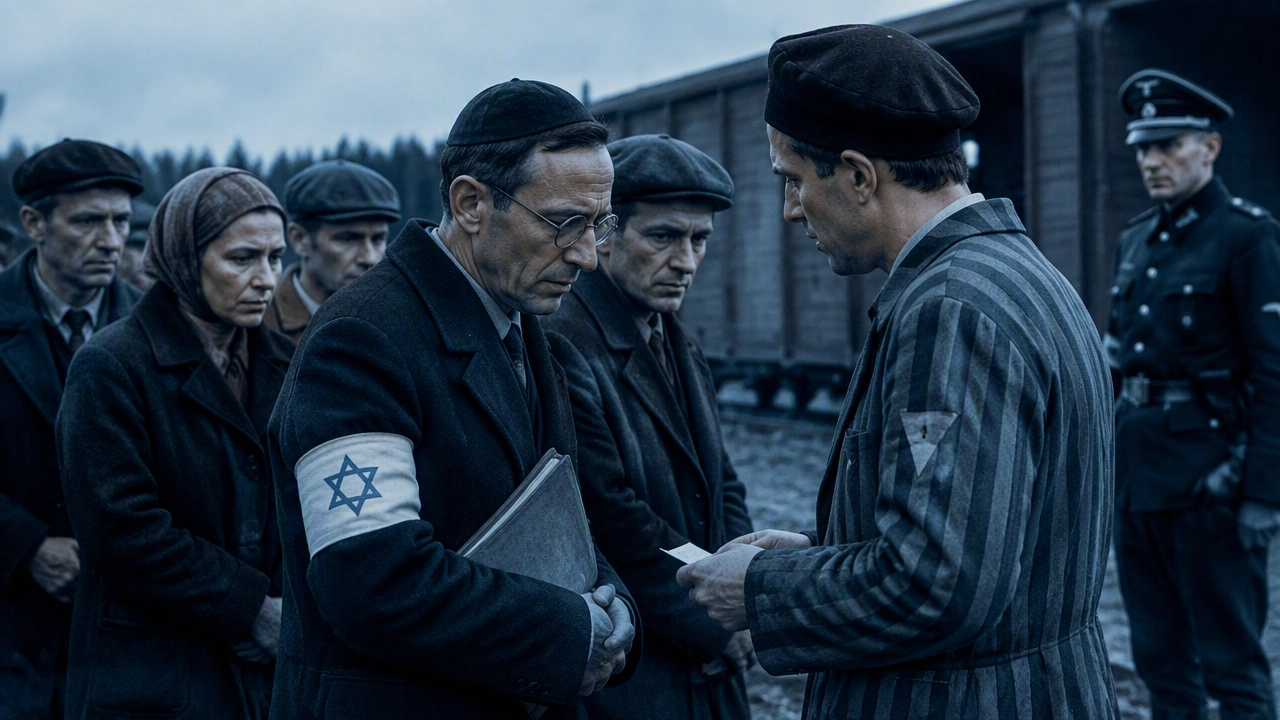
Prisoner functionaries included clerks, interpreters, cooks, tailors, carpenters, and members of work details who supervised small groups under SS oversight. Some were assigned to sort belongings or manage supplies. Others were placed in roles connected to incoming transports. The Jewish council, where it existed within the camp system, was typically a body created under German orders to organize aspects of community life and labor allocation. In camps like Sobibor, any council-like structure operated under extreme coercion and with very limited room for negotiation. Its members were chosen or pressured into service by the camp authorities, and their decisions were constrained by the threat of collective reprisals.
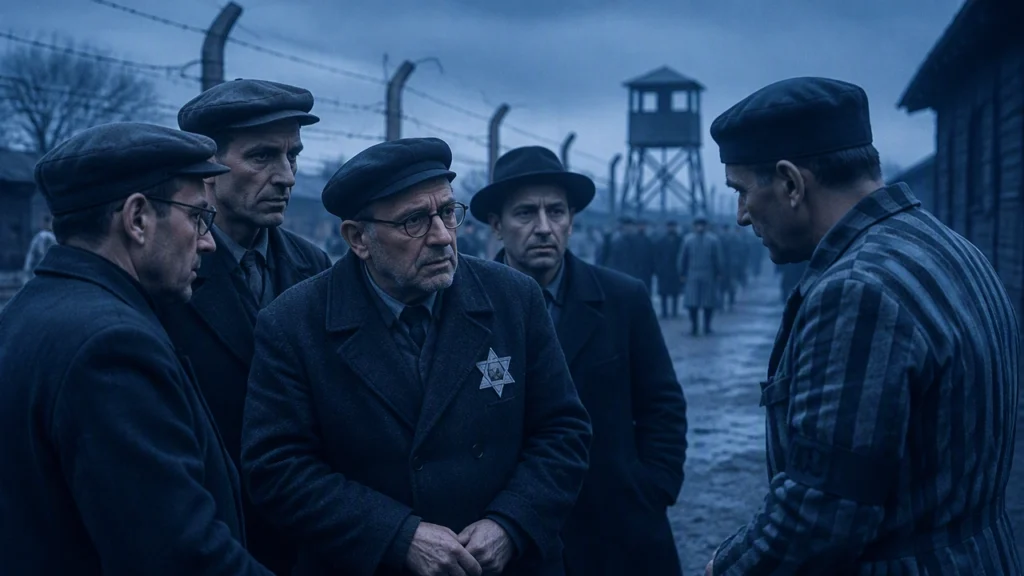
Within this environment, functionaries often had to make choices that could affect the survival of people they knew, while knowing that their own lives were at risk. The camp authorities deliberately fostered uncertainty and fear, making it nearly impossible for functionaries to step outside their assigned roles without endangering themselves and others.
The role of the Jewish council at Sobibor
At Sobibor, the Jewish council’s functions were narrower and more precarious than in ghettos, where councils sometimes organized education, welfare, and limited negotiation with the occupying authorities. In the camp, any council-like body was focused on tasks imposed by the SS: organizing labor details, maintaining records, and facilitating the flow of daily operations. The council had no independent authority. Its members were compelled to act within a framework set by the camp command, and their decisions were subject to immediate reversal or punishment.
The council’s work did not grant protection. It could not stop selections or killings. It could not secure reliable food supplies or ensure humane conditions. What it could do, in some instances, was channel information, clarify orders, or reduce confusion in ways that marginally affected who was assigned to which work detail. Even these small adjustments could matter, because being placed in a detail with access to shelter, food, or less exposure to violence might improve a person’s chances of surviving another day. Yet every such decision carried risk: favoring one person could be seen as disobedience, and the consequences could be severe for the functionary and for those connected to them.
Travişki and the pressures on functionaries
Names like Travişki appear in testimonies as part of the complex network of prisoner roles. Whether as a clerk, a supervisor, or someone involved in the handling of property, a functionary in this position was embedded in a system that demanded compliance. The SS used functionaries to keep the camp’s machinery running, and they did so by creating dependency and fear. Functionaries received marginally better food or shelter at times, but these small advantages came with the constant threat of being replaced, beaten, or killed. The camp authorities also used functionaries as intermediaries to传递 orders, which placed them in visible positions that could attract resentment from fellow prisoners.
This visibility was part of the camp’s control strategy. By forcing prisoners into roles that appeared to confer responsibility, the SS blurred the line between coercion and complicity. Functionaries were made to feel that their actions might spare others from immediate harm, even as the broader system continued its killing. The result was a moral environment of extraordinary pressure, where every choice was bounded by danger and where hindsight cannot easily reconstruct the lived reality of those moments.
Impossible choices and moral endurance
One of the most difficult aspects of Sobibor’s history is the question of how to understand choices made under coercion. Prisoner functionaries often faced scenarios with no safe option: follow an order and participate in a process that could lead to death for others, or refuse and face certain punishment. In some cases, functionaries tried to delay, divert, or soften the impact of orders. They might pass along information, adjust work assignments, or help someone avoid a selection for a brief period. These acts were small and often temporary, but they reflected a form of moral endurance within a system designed to crush it.
At the same time, it is important to avoid simplistic judgments. The camp’s structure ensured that functionaries could not control outcomes. The SS maintained ultimate power over life and death, and they used it arbitrarily. Praising or condemning functionaries as a group risks misunderstanding the nature of coercion. Each person’s situation was shaped by specific circumstances: their skills, their relationships, the timing of their assignment, and the behavior of the guards around them.
Testimony, memory, and careful history
Survivor testimonies about the Jewish council and prisoner functionaries at Sobibor are fragmentary and often shaped by the trauma of the time. Some accounts emphasize the ways functionaries tried to help; others focus on moments of perceived favoritism or harm. These differences do not necessarily contradict each other. They reflect the uneven visibility of actions within the camp and the difficulty of interpreting motives under extreme pressure. Historians use these accounts alongside documents and postwar investigations to build a layered picture of camp life, one that acknowledges both harm and help without collapsing the complexity of the situation.
When writing about figures like Travişki, it is essential to avoid inventing details or assigning roles without evidence. Where sources are limited, it is better to describe the general conditions under which functionaries operated and to note the uncertainties. This approach respects the memory of those who suffered and those who struggled to survive, while maintaining the standards of careful history.
Why this history matters
The story of the Jewish council and prisoner functionaries at Sobibor is not a comfortable one. It asks readers to consider how people behave when choices are constrained by violence and fear. It challenges easy moral categories and insists on attention to context. By examining these roles, we gain a clearer view of how the camp functioned and how individuals navigated a system designed to exploit their labor and their humanity.
Understanding these dynamics also deepens our grasp of the broader history of Sobibor. The camp was not only a site of killing; it was a place where people tried to endure, sometimes by taking on roles that placed them in painful proximity to the machinery of destruction. Recognizing this does not excuse harm, nor does it diminish the suffering of those who were killed. It adds texture to a history that demands both precision and compassion.
Conclusion: holding complexity without compromise
The Jewish council and prisoner functionaries at Sobibor operated under conditions that made moral clarity almost impossible. Their roles were imposed by the SS, their choices were bounded by threat, and their actions were interpreted differently by those around them. To tell their story carefully is to resist simple narratives and to acknowledge the weight of coercion. In doing so, we honor the complexity of Sobibor’s history and the people who lived through it, while maintaining a commitment to evidence, context, and respect for the limits of what we can know.